 Sami Abdel-Shafi in Gaza CityThe Guardian, Thursday 31 July 2014 16.45 BSTJump to comments (540)
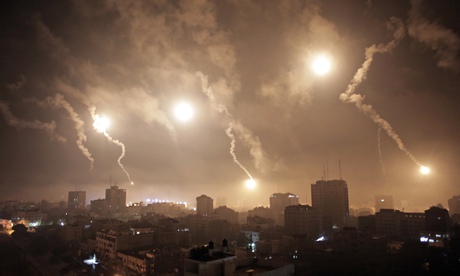 ‘It is difficult to comprehend how the international community seems unable to halt what is an apocalypse for Gaza’s citizens.’ Photograph: Khalil Hamra/AP
To continue to witness children being killed and orphaned, entire families being obliterated and entire neighbourhoods levelled, is beginning to seem physically impossible. No one should have to bear this burden. And yet we in Gaza are being forced to do so. Even those who have sought refuge in apparently protected spaces – such as schools run by the UN – have fallen victim.
Against this backdrop, it is difficult to comprehend how the international community seems unable to halt what is no longer just a war in Gaza but an apocalypse for its citizens. The Gaza Strip is now unlivable. Hundreds of thousands of people who lived close to the perimeter of the territory have been pushed towards its centre. One of the most densely populated districts in the world has not only shrunk but become more dense. Since Gaza’s only electricity generation station was targeted, severe shortages in water and now bread have been exacerbated.
The government of Israel does not seem interested in a ceasefire pact. As recent history amply demonstrates, the ideal next step in Israel’s eyes would be a conclusion of this war without having to engage in any kind of binding agreements with Gaza. It has extended the conflict by making any cessation of hostilities dependent on the destruction of tunnels which lead into Israel, a condition it did not state at the outset. Putting aside the question of whether it was legitimate for Palestinians to dig those tunnels, Israel should not be allowed to cripple prospects for a ceasefire with a requirement that even it has acknowledged will be difficult to achieve.
And what is surely not acceptable any longer is Israel’s continued denial of the reasons those tunnels were resorted to in the first place. Its refusal to address the issue of Gaza as a political question and not as a military one is part of the problem, and the reason for so many civilian deaths.
An explicit recognition by the international community that the conditions civilians are enduring in Gaza are insupportable would boost the prospect of a credible ceasefire. Palestinians would take such recognition as a clear gesture of fairness and goodwill from the world. But, if some aspects of Gaza’s troubles are recognised while others are sidelined – such as the need for a longer term solution – the feeling that the world is still unwilling to appreciate our plight will only be deepened.
Global support and recognition would create space for Palestinians to trust a ceasefire that not only silences the guns but which also recognises the legitimacy of Gaza’s rights. To state the case unmistakably, these are the rights to economic development; free movement and access; an acknowledgment of the inseparability of Gaza and the West Bank and, critically, a commitment to shield ordinary people from the effects of political strife. The active participation of the US, EU and UN as partners and guarantors of an agreement and as empowered monitors of any breaches in its implementation, would be essential. Gaza will also need an immediate and a massive rescue plan, financed and resourced by the Arab world. The people of Gaza must then be given an unimpeded opportunity to develop their own economy and to begin to rely on their own resources.
In short, the international community’s inability to require Israel to end the disaster must change. The case for this is no longer one of politics or military strategy. It is an urgent humanitarian one. It would not be anti-Israel to take these steps. Rather, it would be pro-global: a move to protect human ideals which may one day triumph in genuine resolution and lasting peace.
Gaza conflict: Israel calls up 16,000 reserve soldiers
Out of media player. Press enter to return or tab to continue.
A deadly strike on a UN-run school in Gaza led to pain, fear and grief, as Ian Pannell reports
Continue reading the main story
Israel is calling up 16,000 extra reservists to bolster its military as the conflict in Gaza continues.
The move brings the total number of reserves called up by Israel to 86,000. Officials say it will give the army scope to maintain operations.
Separately, Israel has pledged to investigate a strike on a UN-run school that killed at least 16 people.
The UN says it is sheltering 225,178 Palestinians in 86 shelters across Gaza, with 200,000 more displaced.
Most of those others have left their homes and are staying with friends or family.
The total number displaced amounts to 25% of all of Gaza's 1.7 million inhabitants.
Israel began Operation Protective Edge on 8 July. Since then at least 1,360 Palestinians have been killed. Most have been civilians.
Some 58 Israelis have been killed, 56 soldiers and two civilians. A Thai worker in Israel has also died.
 The UN school hit on Wednesday was sheltering more than 3,000 displaced Palestinians
More detail: Life in the Gaza Strip
'Universal shame'
More than 100 people in Gaza were killed on Wednesday, Palestinian officials said.
The attack on the school in the Jabaliya refugee camp, which was sheltering more than 3,000 civilians, took place on Wednesday morning.
The US and UN condemned the attack, with UN Secretary General Ban Ki-moon calling it "unjustifiable".
Out of media player. Press enter to return or tab to continue.
Mark Regev: "If we find that it was errant fire from Israel I'm sure we will apologise"
He said "all available evidence" suggested Israeli artillery was the cause.
Spokesman Mark Regev told the BBC Israel would apologise if it discovered that its fire was responsible for the strike on the school.
"We have a policy - we don't target civilians," he said.
"It's not clear to us that it was our fire but we know for a fact there was hostile fire on our people from the vicinity of the school."
Speaking to the BBC's Newsnight, he accused Hamas of hiding weapons in civilian facilities and UN shelters.
Out of media player. Press enter to return or tab to continue.
Hours after the school attack, a strike on a busy market in Shejaiya killed 17 people, as Martin Patience reports
Unrwa spokesman Chris Gunness told the BBC that Israel had been told 17 times that the school was housing displaced people, saying the attack caused "universal shame".
He later tweeted that the agency was at "breaking point".
On Wednesday, Israel's security cabinet approved more strikes against Palestinian militant group Hamas, which controls Gaza.
Operations would continue against suspected militants, suspected rocket sites and a network of tunnels discovered leading into Israel, the military said.
Out of media player. Press enter to return or tab to continue.
One of Israel's main objectives is to destroy tunnels used by militants, as Orla Guerin reports
At least 19 air strikes were carried out overnight, officials said, while rocket alarm sirens were heard in southern Israel on Thursday morning.
'Strong support'
The current conflict, now in its 24th day, is the longest between Israel and militants from Gaza.
A 2012 offensive lasted for eight days, and the 2008 conflict went on for 22 days.
The Gaza Strip, sandwiched between Israel and Egypt, has been a recurring flashpoint in the Israel-Palestinian conflict for years.
 There is strong support in Israel for the ongoing military operation and backing for its soldiers
Hostilities increased after the abduction and killing of three Israeli teenagers in June. Israel blamed Hamas and carried out a crackdown on the group in the West Bank. Hamas denied being behind the killings.
Tensions rose further after the suspected revenge killing of a Palestinian teenager in Jerusalem on 2 July. Six Jewish suspects were arrested over the youth's abduction and murder.
Recent opinion polls in Israel suggest strong support for the military operation.
Hamas says it will not stop fighting until a blockade, maintained by both Israel and Egypt, is lifted.
Israel occupied Gaza in the 1967 Middle East war and only pulled its troops and settlers out in 2005. Israel considered this the end of the occupation, but it still exercises control over most of Gaza's borders, water and airspace. Egypt controls Gaza's southern border.


