전 대륙에서 시장조사와 여론조사를 하는 글로벌 네트워크 WIN(Worldwide Independent Network of Market Research)은 매년 건강, 환경, IT 등 여러 분야 현안에 관해 다국가 조사를 하고 있습니다. WIN Worldviews Survey 2025는 2024년 12월~2024년 2월 39개국 성인을 대상으로 했습니다.
오늘은 첫 순서로 세계 면역 주간(4월 24~30일)을 맞아 의약품과 백신 관련 인식을 전합니다.
의약품, 백신 관련 인식: WIN 다국가 조사
→ 한국+세계 조사 결과 파일 다운로드(PDF)
/ 세계 조사 개요
· 2024년 12월~2025년 2월 38개국 성인 총 33,913명 전화/온라인/면접조사(주제별 참여국 상이)
/ 한국 조사 개요
· 조사기간: 2025년 1월 16~24일
· 표본추출: 사회연구패널★에서 성·연령·지역별 층화 추출
(한국갤럽이 무선전화 RDD 방식으로 구축·운영하는 확률 기반 조사패널)
· 응답방식: 모바일조사(조사대상자에게 문자메시지 발송, 자기기입식 웹조사)
· 조사대상: 전국 만 19~79세 1,085명
· 표본오차: ±3.0%포인트(95% 신뢰수준)
· 문자 발송 대비 응답 완료율: 36.5%(총 2,973명 중 1,085명)
· 의뢰처: 한국갤럽-WIN 자체 조사
/ 조사 문항(아래 순서대로 질문)
→ 의약품 유형별 느낌: 유전적 특성 맞춤형, DNA 상호작용형, 세포 구성 요소 상호작용형
→ 백신 유형별 접종 의향: mRNA 백신, 전통적 백신
→ (영문) WIN commentary
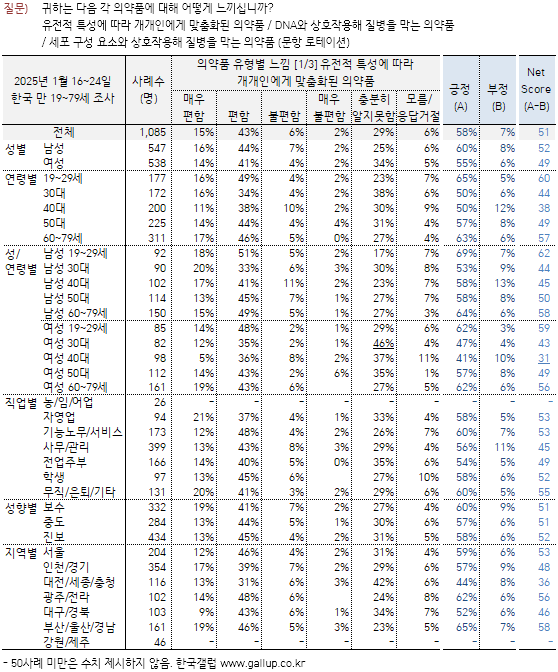
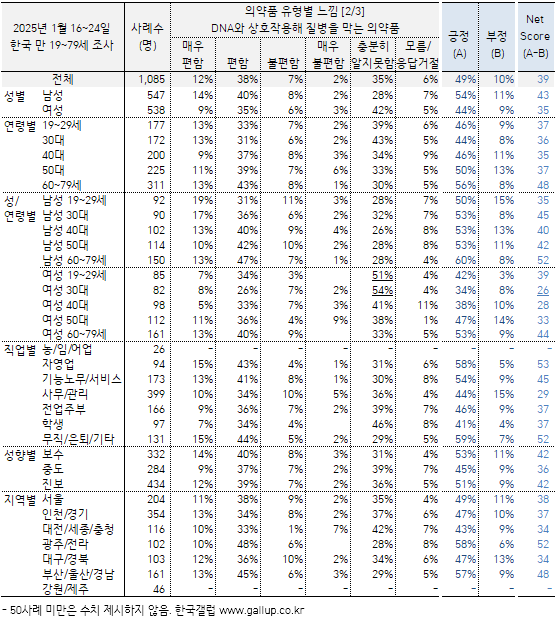
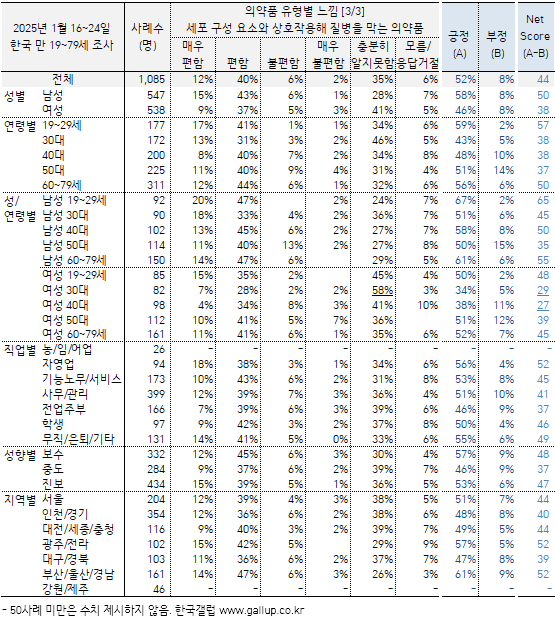
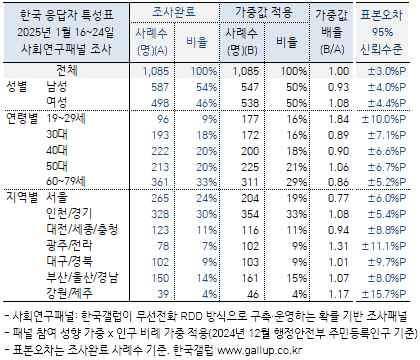
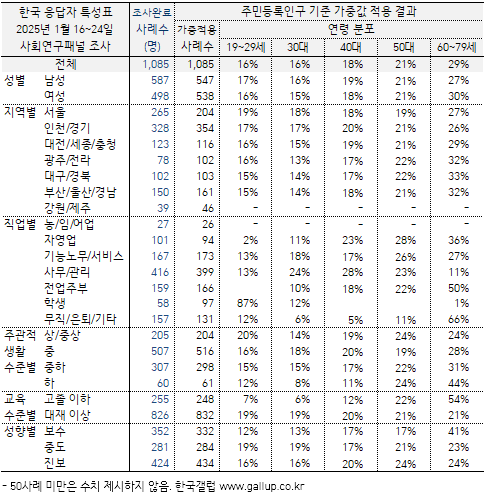
→ 한국 응답자 특성표
요약
[개인 맞춤화, DNA 상호작용, 세포 상호작용 의약품 관련 인식]
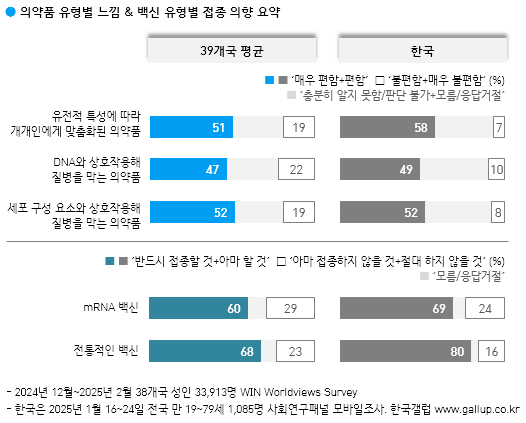
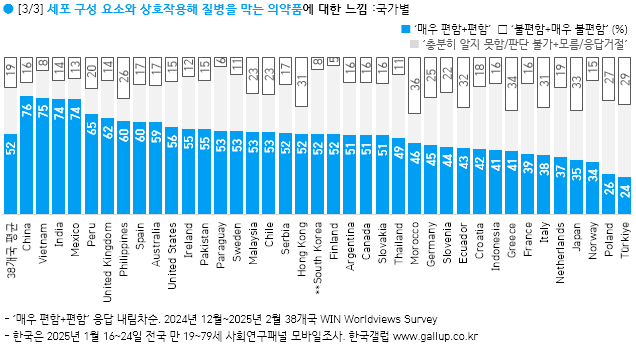
38개국 성인 절반가량 '편하게 느낀다', '불편' 약 20%, 판단 유보 약 30%
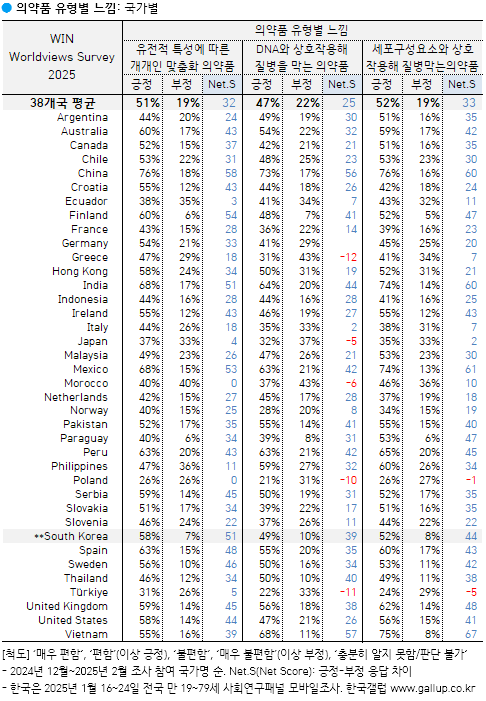
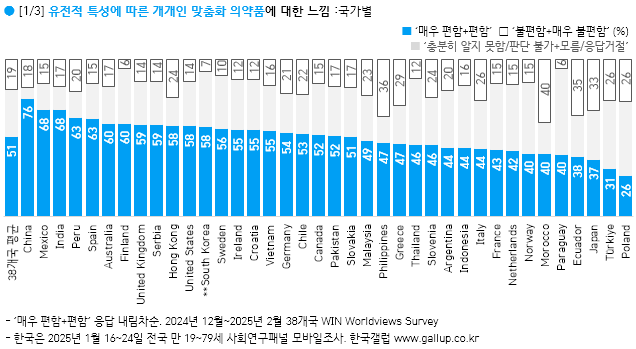
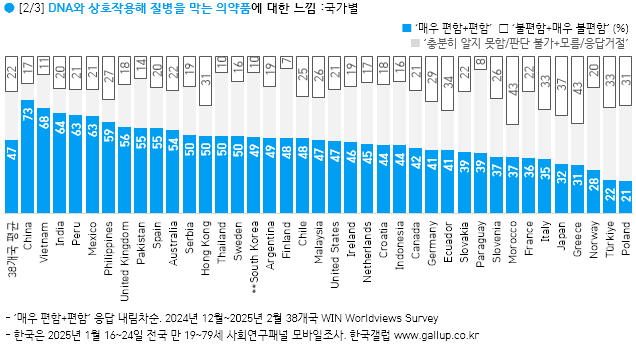
· 중국은 신약에 가장 전향적, 한국은 세계 평균 수준, 일본은 하위권
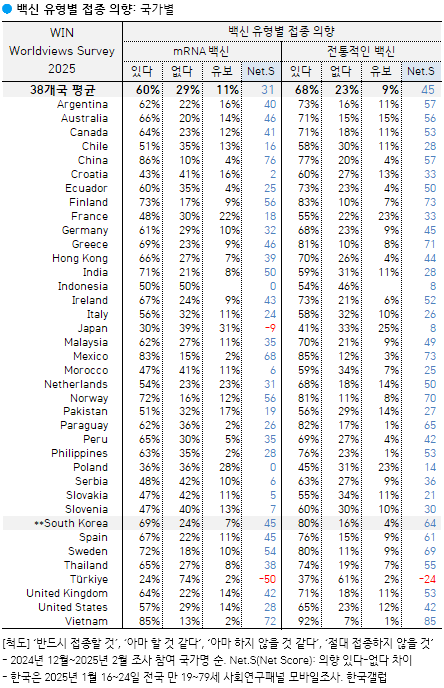
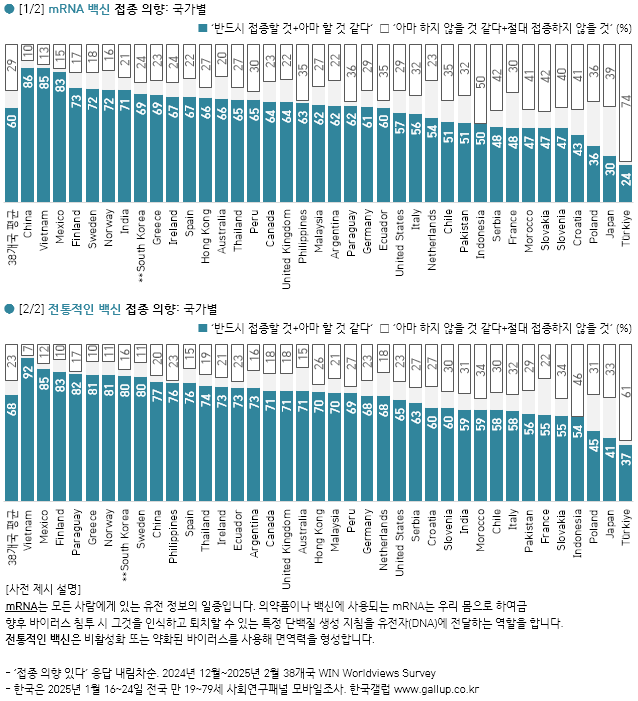
[백신 접종 의향] 전통적인 백신 68%, mRNA 백신 60%
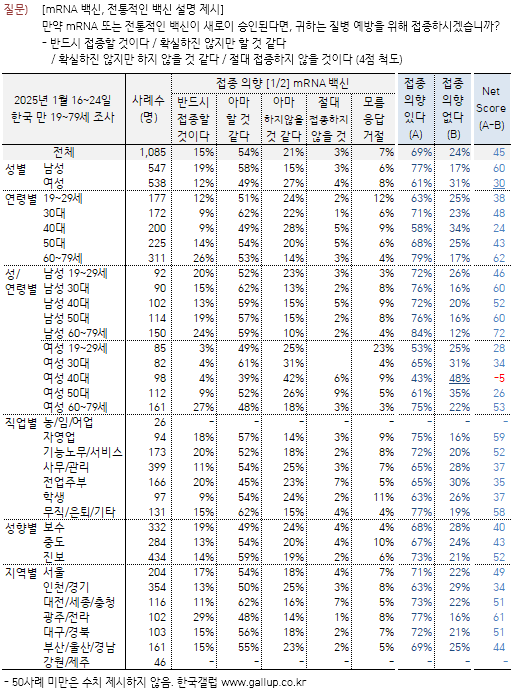
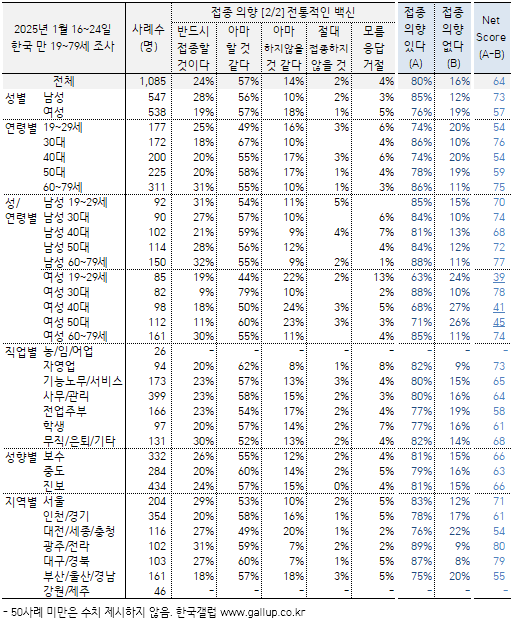
· 젊은층, 고학력자가 mRNA 백신에 더 개방적
· 튀르키예, 열에 예닐곱 백신 접종 거부
· 한국 여성, 남성 대비 백신 접종 의향 낮은 편
[참고] mRNA 기술은 코로나19 백신에 처음 적용·상용화
→ 코로나19 관련 조사 목록 2020.2-2023.3
조사 결과
────────────
의약품 유형별 느낌
────────────
────────────
백신 유형별 접종 의향
────────────
──────────────────
Global discomfort with biomedical innovation signals urgent challenge
──────────────────
The Worldwide Independent Network of MR (WIN), the leading global association of independent market research and polling firms, has released new findings from its Worldviews Survey. This year’s survey captures the perspective and beliefs of 33,913 individuals across 38 countries. The latest findings shed light on global hesitation towards new biomedical innovations, like mRNA, while some uncertainty even with traditional vaccines persists. Tracking trends over six years, WIN has assessed and provided valuable insights into global progress.
The summary of the findings is as follows:
1. mRNA vaccine acceptance still lags behind traditional vaccines
mRNA is a type of genetic information that everyone has. When used in medicine or vaccines, mRNA delivers instructions to our genes (DNA) to make specific proteins that enable our body to recognise and fight off viruses if it encounters them in the future. On the other side, traditional vaccines use an inactive or weakened virus to build immunity.
Globally, 68% of people are willing to accept new developments of traditional vaccines. However, while still substantial, acceptance for mRNA vaccines drops to 60%, revealing a clear global preference for traditional approaches. While traditional vaccine acceptance remains fairly consistent across age groups, women over 35 show noticeably lower acceptance for both types.
As expected, demographic and regional factors influence attitudes towards mRNA vaccines. Younger people, those over 65, and those with higher education tend to be more open to mRNA innovation. For example, 70% of master’s or PhD graduates would ‘definitely’ take a newly approved mRNA vaccine, whereas only 51% of those with little to no basic education would.
Acceptance also varies significantly by country. The preference for traditional vaccines over mRNA ones is most pronounced in Paraguay at a 20% gap, followed by Croatia (17%), and the Serbia (15%). However, China and India challenge this pattern: mRNA vaccines are preferred – with China leading globally at 86% acceptance.
Professor Heidi J. Larson, PhD.; Founder and Director of the Vaccine Confidence Project, and Professor of Anthropology, Risk and Decision Science at London School of Hygiene & Tropical Medicine, says:
"In general, publics tend to hesitate when new vaccines are introduced, especially those made in new ways (i.e. the Covid-19 vaccine was the first vaccine aver to use an mRNA approach). The perceptions of mRNA and future RNA related vaccines and medicines should be monitored over time as people become more familiar with this new approach to making vaccines and medicines, but at the same time, risk seeing more misinformation.”
2. Discomfort remains for biomedical innovations, but varies country by country
When asked about their comfort with new biomedical innovations, global responses were moderate: 51% with personalized medicine, 52% felt comfortable with cell-interacting medicines and 47% with DNA-interacting medicines. However, 30% of the global population responded ‘I don’t know’ for each – highlighting a significant gap in public understanding and a clear opportunity for better public education and communication.
More than just public education, the numbers suggest that the language used to describe these innovations impacts comfort levels. This underscores the importance of using clear, accessible, and carefully considered terminology when explaining how new health technologies work.
Regionally, the APAC region leads in comfort levels, followed by the Americas, then Europe and the MENA region expressing most discomfort. Notably, China ranks highest in comfort levels for personalized medicine (76%), DNA-interacting (73%), and cell-interacting (76%) medicines. In contrast, Japan appears amongst the least comfortable countries, with just 37%, 32%, 35% comfort levels for each type, respectively.
Younger people (18-24) are more open to biomedical innovations, while those over 65 show the highest uncertainty, reaching 4 out of 10 individuals. As with mRNA vaccine acceptance, those with higher education correlates with greater comfort, reinforcing the influence of both regional and socioeconomic factors in shaping public trust in biotechnology.
3. Traditional vaccination acceptance cannot be assumed
Despite decades of public health success, a notable minority still reject traditional vaccines (23%). Turkey leads with a 61% unwilling to take them, followed by Indonesia (46%), Slovakia (34%), Japan (33%), and Poland (31%). With nearly one-third of people globally either reject or are unsure about traditional vaccines – this is not a marginal group.
The research highlights key patterns: rejection is more likely amongst those with lower education 43%, compared to just 24% of master’s or PhD graduates. Women also show greater hesitancy, with 33% saying they would not or are uncertain. These findings underscore that trust in traditional vaccination cannot be taken for granted – continuous, targeted communication is essential to build and sustain public confidence.
4. Moving forwards in a world with cautious optimism
The Worldviews Survey paints a picture of cautious optimism toward biomedical technology. While many are open to innovations like mRNA vaccines, hesitancy – especially around traditional vaccines – remains a pressing concern. These insights offer a clear call to action: rebuild trust in traditional vaccines where it's eroding, communicate clearly to address uncertainty, and prioritise engagement with women, older adults, and those with less education. Crucially, efforts must also be tailored to the cultural context of each region.
Only by addressing the root causes of vaccine and medicine doubt can we fully realise the global potential of immunisation.
Richard Colwell,
President of WIN International Association, states:
“This year’s findings highlight a world cautiously stepping into a new era of medicine. While innovation is gaining ground, WIN hopes that the findings from Worldviews Survey reminds us that trust cannot be taken for granted. Rebuilding confidence in traditional vaccines and fostering understanding of new technologies must be global health priorities.”
───
한국 응답자 특성표
![블랙핑크 제니, '파격 노출' 몽환적 화보 공개 [블랙핑크, 걸크러쉬 매력]](https://thumb.pann.com/tc_253x230/https://news.nateimg.co.kr/etc/cms/2026/05/19/1779180042_759.jpg)
!["공승연 덕분에 건강 회복"…트와이스 정연, 몰라보게 예뻐진 근황 [아이돌-트와이스, 미모가 '샤샤샤']](https://thumb.pann.com/tc_253x230/https://news.nateimg.co.kr/etc/cms/2026/05/19/1779178910_549.jpg)

