Samarkand history goes deep into thousand years. Archeological finds and annalistic proceedings of eyewitnesses and ancient historians allowed to establish with full reliability that a man had been living on the territory of modern city many thousand years ago B.C Registan Square, Samarkand
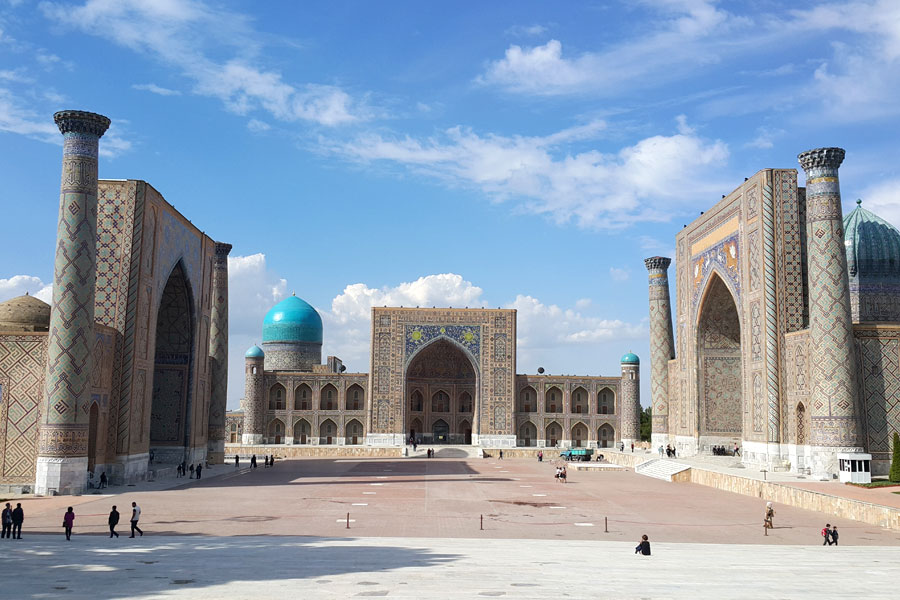 During centuries Registan Square was the center of Samarkand. The word Registan means ㅤㅂㅑㄶand place? There was a river running there many ages ago, before building the first Madrassah on the square. Years passed, the river dried out and left lots of sank there, that was the first place where the first Madrassah was built in the beginning of the 15th century and named Registan square. As the Madrassah was first built, all the holidays, parades, festivals and Sunday bazaars took place.
 The ensemble consists of three Madrassah: Ulugbek Madrassah (15th century), Sher ?Dor Madrassah (17th century) and Tilla-Kari Madrassah (gold covered)(17th century).
Madrassah?is the Muslim high educational institution. Only the boys from reach families studied there. The training lasted for 10, 12, 20 years. It was up to the discipline the student selected. The main discipline for all of them was Learning Koran. The rest of the subjects were not obligatory and could be selected by students.
The Ulugbek Madrassah was built by the Ulugbekㅤㅁㅝㅌ order and guidance. It lasted only three years from 1417 to 1420. When the medresse was constructed, Ulugbek gave lectures on mathematics and astronomy till his death.
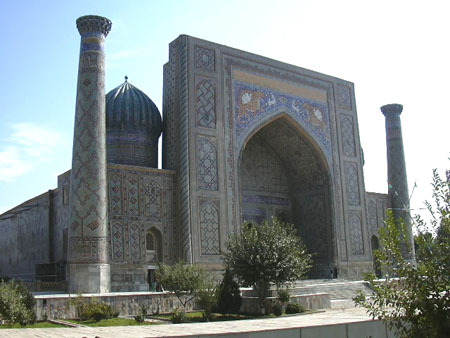 Two years later, the ruler of Samarkand Yalangtush Bahadur ordered to build the copy of the Madrassah, and the second Sher-Dor Madrassah was built opposite it. The only difference was that it had two more winter teaching halls, but the main structure was the same as in Ulugbek Madrassah.
Several years later, the same ruler of Samarkand ordered the third Tilla-Kari Madrassah. Itㅤㅁㅝㅌ outward is the same as those two other medresses, but coming in youㅤㅁㅝㅁl see a one story building. To make the architectural ensemble, the architecture made two floors on the outside but only one inside. Madrassah was always built by one project ?four-cornered yard with four terraces and cells along the whole perimeter. The main entrance was always locked with lattice and two other entrances were used by purpose. The doors in cell were always low because ㅤㅁㅣㅍslam?means ㅤㅂㅐㅎbedience? that is why everyone who entered or went out of cell always had to bow, it was like greeting and wishing health to everyone.
Only Tilla-Kari Madrassah was bult like medresse, but was used mostly as mosque; just looking at minarets can see this, Tilla-Kari has low minarets to call people to pray.
In 17th century Till-Kari mosque and Madrassah was the biggest mosque in Samarkand. Right up to 19th century Madrassah and Madrassah-mosque was used by purpose, and only from the beginning of 20th century till now they serve as monuments.
ㅤㅁㅣㅀden of Ancient East? ㅤㅂㅏㅀrecious Pearl of Islam World? ?Rome of East? ㅤㅂㅏㅆui Zamin?ㅤㅁㅣㅄace of Earth?with such magnificent names poets, historians, medieval geographers of Iran, India, China, Byzantium, Egypt called Samarkand.
Even though of such magnificent description Samarkand saw many sites of fire and destructions, which left their sign in history.
During centuries Samarkand was gained by different nomadic and half nomadic generations, which always were destroying, sacking, and leaving ruins after them.
Samarkand saw three the largest tragedies.
1. The first ine is related to the time of Aleksandr Macedonianㅤㅁㅝㅌ gains in 329 year BC; the city was fully destroyed, citizens were exterminated. After reconstruction of the city there was a development of different crafts, the east and Greek cultures mixed together, and this left its sign in the history of Samarkand.
2. The second tragedy is related to 8th century, when Arabs were gaining the Central Asia. Stating from 8th century Islam became main religion in Central Asia. Before that time there were different religions in Central Asia but the main was zoroastrism. And only Arabs with sword and fire, destroying people brought new religion Islam to Central Asia. And till now it is still main religion here.
3. Third tragedy is related to 13th century, when Chigiz han was gaining the central asia. When the city was destroyed, Samarkand ame to the new decline. And only in 14th century when Timur came to the power Samarkand was reconstructed. 14-15th centuries are called the Renaissance because Timur brought scientists from each aggressive crusade. In particular he was assisted in development of different sciences in Central Asia.
Samarkand reached the highest level of development only during Timurㅤㅁㅝㅌ government, though he is described as cruel gainer in history. All this was happened because during 35 year he brought with him mathematicians, astronomers, architectures, and musicians from his aggressive campaigns to his country.
Architectures from many countries participated in the construction of many monuments. Various d?or, and picture of rising sun with lions chasing after fallow-deers is the illustration of it. It is not allow illustrating animals and people in Islam. But Sher-Dor medresse is decorated exactly with pictures of animals.
What is concerned about decoration of the whole ensemble, here it is possible to see the difference in designing of tympanums of every medresse. If in Ulugbek medresse cable is often repeating, but in 17th century medresse no picture is repeated because it was prohibited in that time to repeat the pictures in architectures work. Geometric, letter design, and crockets were used in designing Bibi Hanim, Samarkand
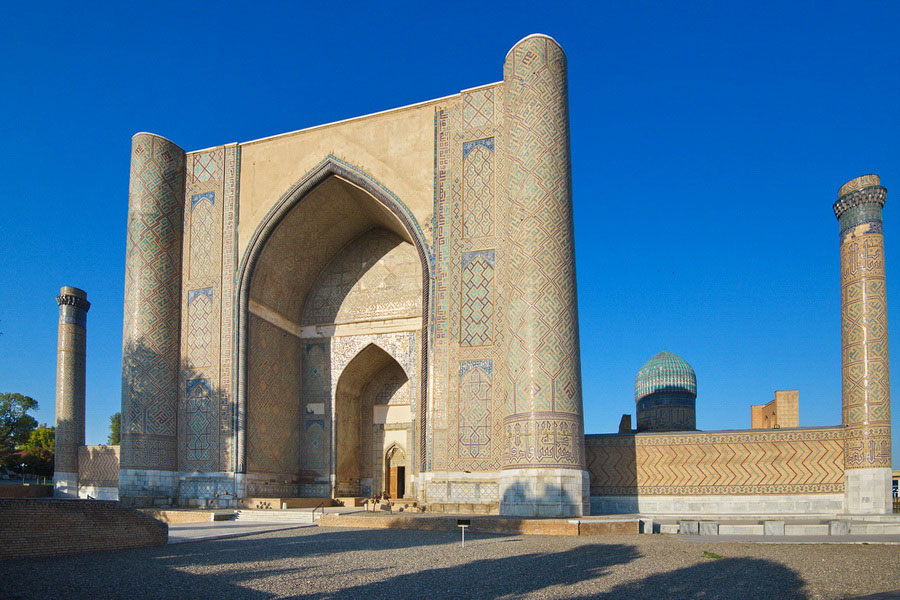 Its construction was started in 1399, after successful campaign of Timur to India. Mosque was under construction during 5 years. Its structure was finished in 1404. By Timurㅤㅁㅝㅌ idea Bibi Hanim mosque had to eclipse all that he had seen before in other countries. Architects, artists, masters and craftsmen from many East countries were involved in construction. Two hundred stonemasons from Azerbaijan, Fars, Hindustan and other countries were working inside the mosque, and five hundred workers in mountains near Pendjikent were working under production and trimming of stones and sending it to Samarkand. Masters and craftsman gathered and drive together from all parts of the world put into construction their traditions and experience.
 Building was not finished when Timur went to one of his new campaigns. After he came back he went to see new mosque.
Grandiose buildings occupied rectangular yard with size 130r102 meter. On his west side towered the maim mosque, on north and south sides were small mosques. Spacious inside yard was covered by marble flagstones and enclosed with sheltered gallery for pilgrims. The entrance to the court was decorated as high portal with two round minarets that were 50 meters in height. Font of cathedral mosque was also designed with grandiose portal with two minarets. The wall of all buildings outside was decorated with multicolored glaze bricks, which made intricate geometric ornamental design and religious aphorisms. Magnificent and rich decoration of inside buildings consisted of majolica mosaic, carved marble, stamping on papier-m?h? gilded design.
However Timur was not satisfied with building and in a fit of anger ordered to seize magnates Hodja Mahmud David and Muhammed Djelda who managed the construction. They were sentenced to death and hanged behind Siab channel, at the foot of Chupanat.
There is a legend about construction of Bibi-Hanim mosque that is still known in our days.
Beauty woman Bibi-Hanim, Timurㅤㅁㅝㅌ wife, decided to surprise and make glad her husband. When he was absent being in one of his campaigns she called to the palace the best constructors and masters of Samarkand and suggested them construct the building. The work started immediately. The walls were growing very fast. More often Bibi-Hanim visited the building site. She hurried the main architect to finish the work. But charmed with queenㅤㅁㅝㅌ beauty architect did not to hurry constructors.
Meanwhile the message came to Samarkand about Timurㅤㅁㅝㅌ coming soon. Bibi-Hanim was ranting and raving. Then architect made term: ㅤㅂㅏㅊhe mosque will be constructed in time, but ?you tsarina will give me a kiss? Tsarina was indignant: ?I will give any of my bondwomen by your choice. Why are you looking only at me? Look at these colored eggs, that have different colors and do not look like each other, but if you will break them, will they really differ? Such are we, women.?BR>But architect insisted: ?I will answer you. Here are two the same glasses. One of then I will bumper with crystal water, the other with white wine. They are the same, but if I will touch them with my lips then one of them will burn me with molten fire, and I wonㅤㅁㅝㅍ feel the other one. That is love.?BR>Timur was already close to Samarkand. Vexation of Bibi-Hanim did not know limits. So long cherished surprise for master was under the threat. Besides, as legend says, architect was handsome and young. And she agreed. Architect blended to beautiful Bibi-Hanim. At the last moment she tried to protect herself with palm. But the kiss was so passionate, that ardor got through arm of beauty and left crimson spot on her cheek.
After few days Timur came to city. In front of his look raised cupolas and minarets amazed with its magnificence. But his gladness was darkened. He became furious when he saw sign from the kiss. Bibi-Hanim told him the truth. By order of Iron Lame Man warders started look for architect. Escaping from pursuit he with his apprentice climbed on minaret of mosque.
And when warders run up by numerous steps, they found only one apprentice. ?Where is architect??They asked. ㅤㅂㅏㅊeacher made for him wings and flew away to Meshed?he answered.
That is the legend. History dies not know the name Bibi-Hanim. It is only known that elder wife of Timur was called Saray-Mulk-Hanum. Shakhi-Zinda, Samarkand
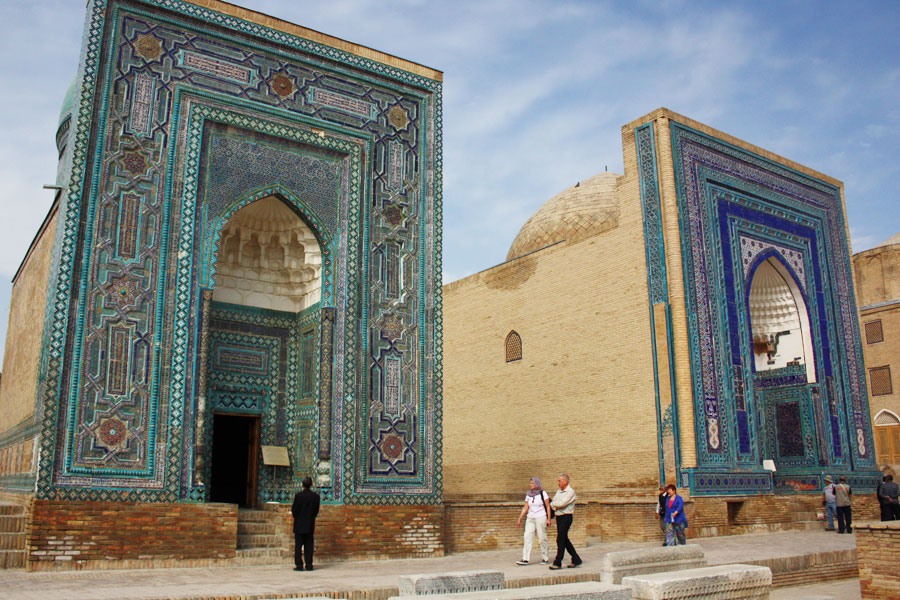 On south-east slope of Afrosiab is situated one of the notable architectural ensemble of Samarkand-Shakhi-Zinda necropolis. It consists of 11 mausoleums, built on to each other during 14-15th centuries in series.
Entrance portal Shakhi-Zinda completing all ensembles is the latest construction. Inscription under entrance says: ?This magnificent building established by Abdulazizhan, Ulugbek-Gurganㅤㅁㅝㅌ son, Shahruhㅤㅁㅝㅌ son, Amir Timur-Guraganㅤㅁㅝㅌ son, in 883.?(1434 AC)
All ensemble divides into three parts: Entrance chartak (consisting from mosque of hudjra, summer mosque, Davlyat Kushbegi mosque amd mausoleum that had for a long time the name Kazi-Zade Rumi).
Middle chartak (consisting of: mausoleums Emir-Zade, Emir-Husein, Shadi-Mulk, Shirin-Bibi-aka, Octahedron, Usto Ali, Nameless, Burunduk, Hudjra, Kusama ibn-Abbasa mosque, Ziarathani and Kusam ibn-Abbas mausoleum.)
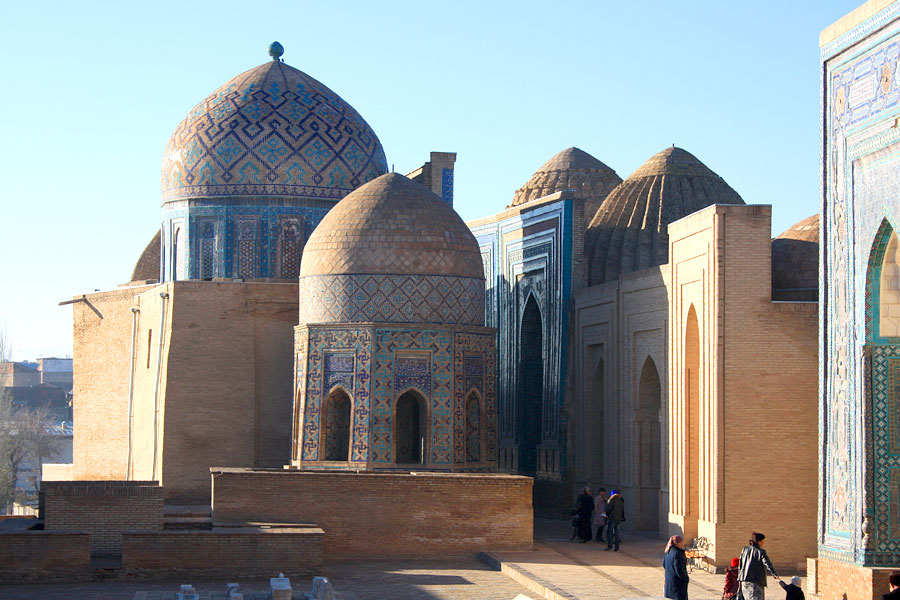 Upper chartak (consists of : Tuman-aka mosque, Tuman-aka mausoleum, nameless mausoleum 1360-1361, Hodja Ahmad mausoleum.)
Going magnigient upstairs of Shakhi-Zinda and entering to the cool twilight of narrow corridor, visitor make kind of journey into the heart of time. The farther it is the more ancient buildings are. The first mausoleum from the left was thought as mausoleum of Timurㅤㅁㅝㅌ friend and teacher astronomer Kazi-Zade Rumi.
But in 60-70th years after opening graves scientits found out that two women were buried here. It is assumed that this was Timurㅤㅁㅝㅌ wet-nurse and her daughter.
Going up by 36 footsteps of old stairs you find yourself in the open gallery. Here from the left and right are mausoleums burial-vast of closest relatives of Timur and confidant of court.
First mausoleums from the left and right Emir-Zade mausoleum and Emit-Husin mausoleum belong to confidant people of his court.
Next mausoleum from the left belongs to Timurㅤㅁㅝㅌ niece Shadi-Mulk aka. She died when she was very young that is why Timur ordered to build mausoleum of the most elegant form, to show beauty and youth of his niece. Timurㅤㅁㅝㅌ sister Shirin-Bibi aka was managing the construction of this mausoleum. After finishing of this construction, she ordered to build mausoleum for herself against her nieceㅤㅁㅝㅌ mausoleum. Both these mausoleums were built in 1371-1373 years.
Going a little bit farther we see mausoleum of original form. This nameless mausoleum was build by architectures from Azerbaijan. One detail that differentiates this mausoleum from others is that entrance to crypt where graves are situated goes to central side street, and all other mausoleums have entrance behind the mausoleum.
Next row of mausoleums is called nameless becoase all these mausoleums were built in 11th century and during Chigiz-Hanㅤㅁㅝㅌ invation almost all of then were destroyed. Now you can see onle small saved remains from mausoleums of 1th century. One of the nameless mausoleums is sometimes called Usto Ali Nesefi y the name of architect.
Next mausoleum has name of commander-in-chief of Timurㅤㅁㅝㅌ army-Emir Burunduk.
Farther goes the most aincient ensemble of all necropolises ㅤㅃㅓㄼnsemble of Kusam ibn-Abbas. This is the oldest building of 11th century. The name of entire necropolis is related to the name of Kusam ibn-Abbas. Kusam ibn Abbas means ㅤㅂㅐㄶlive king?
In 8th century during one of the sermon Kusam ibn-Abbas was beheaded, but because he was holy, he said that a man dieing on the way to God couldnㅤㅁㅝㅍ be killed. He took his head put it underarm, and descended to shaft, where hi is living till now. The mausoleum was built in 11th century, and cupola was rebuild in 14th century by order of Amir Temur.
And in the last yard three mausoleums are situated: unknown mausoleum( from the right), Tuman-aka mosque (from the left), Hodja Ahmad mausoleum. All these mausoleums were built in 14th century. By looking at decoration of two mausoleums nameless and Hodja Ahmad it is possible to say that they were built by architectures from Samarkand, main colors used by them -white, blue, and dark blue- reside to architectural school of Samarkand. While in Tuman-aka mausoleum green, yellow, black, and red colors were used. To the left of mausoleums is situated the entrance to the biggest Muslim cemetery built in 9th century and used till present time Gur-Emir, Samarkand
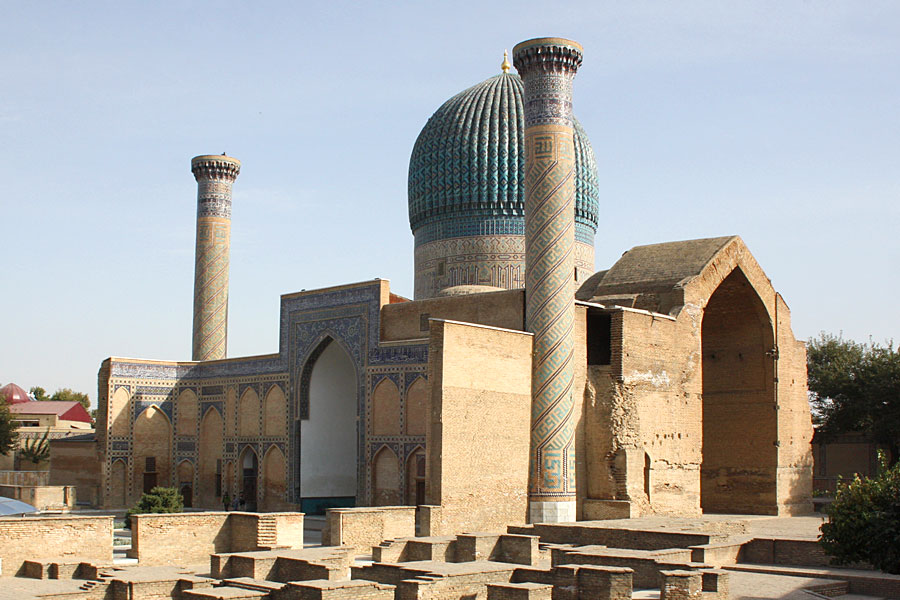
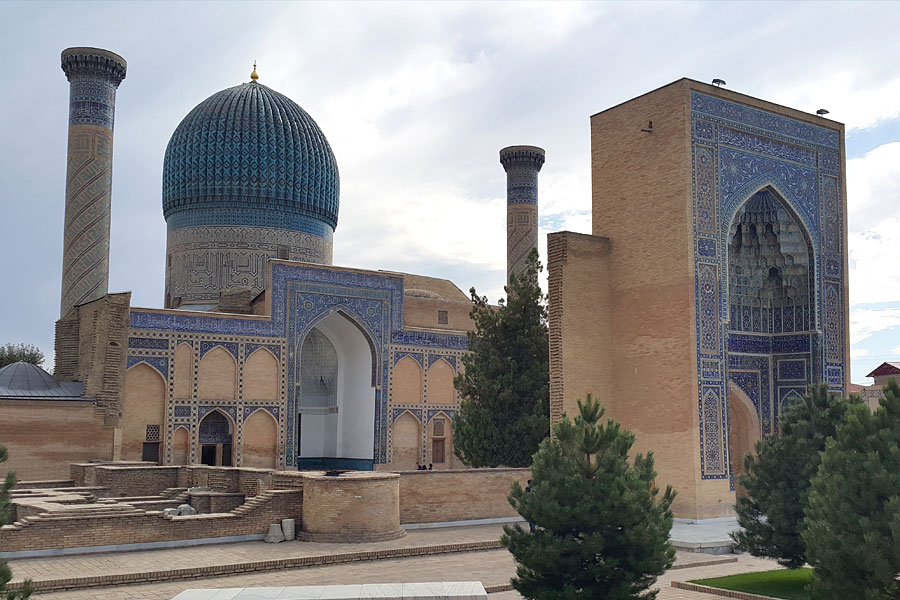 Gur-Emir means ㅤㅂㅐㄾrave of Emir? Gur-Emir Mausoleum was built in 1404 for Timurㅤㅁㅝㅌ grandson Muhhamed Sultan. He had to become heir apparent of throne after Timur, but in 1404 he died and Timur ordered to buid big mausoleum for his loved grandson. In 1405 Timur died in Otrar city and his sons decided to move his body and bury him near his favorite grandson. From that time this mausoleum was called ㅤㅂㅐㄷurial-vault of timurids? Here two sons of Timur were buried-Shahruh and Miranshah, also second grandson Ulugbek, spiritual director of Timur Muslim sheikh from Medin-Mir Seid Bereke and some Shah-Hodja.
 Gur-Emir Mausoleum consists of several parts: yard of Muhammed Sultan ensemble, to the right of mausoleum hanaka(the place where Muslims can pray), to the left is medresse and in the center the mausoleum itself decorated from each side with minarets. Unfortunately neither the medresse nor hanaka were saved. In 1996 it was big reconstruction here when Samarkand celebrated 660 years from Amir Temurㅤㅁㅝㅌ birthday. Original design is saved inside. Decorators only drew on original thin layer of paint.
 Every headstone is made from marble, only Timurㅤㅁㅝㅌ headstone is from nephritis, it was brought by order of Ulugbek and put on grave of Timur. All headstones in upper mausoleum are saved very well, but in lower because of floods almost all of them were destroyed. Lattice that set off all headstones was made in 15th century from marble by Ulugbek order.
 All headstones were opened in June 1941. There is a legend that related to this event. Before opening three old men told scientists not to disturb ashes of dead, especially Timurㅤㅁㅝㅌ ashes, because by opening his grave they could restore the spirit of war. But scientists had goal to know whether Timur was beheaded, and Timur was lame, because in history Timur is mentioned as Tamerlan-ㅤㅂㅐㅀron lame man? After opening sarcophagus scientists saw grave where skeleton of Timur was. By analysis of skull bone anthropologist Gerasimov made first portrait of Timur and his entire dynasty. Scientists concluded that he was really lame because his one leg was shorter than another. They also established that Ulugbek was beheaded. His skull was near skeleton. Timurㅤㅁㅝㅌ skeleton was examined in Leningrad, and then all remains were returned back to the grave. Two days later World War Two began and many citizens were saying that it started because of opening Timurㅤㅁㅝㅌ grave. Ulugbekㅤㅁㅝㅌ observatory, Samarkand
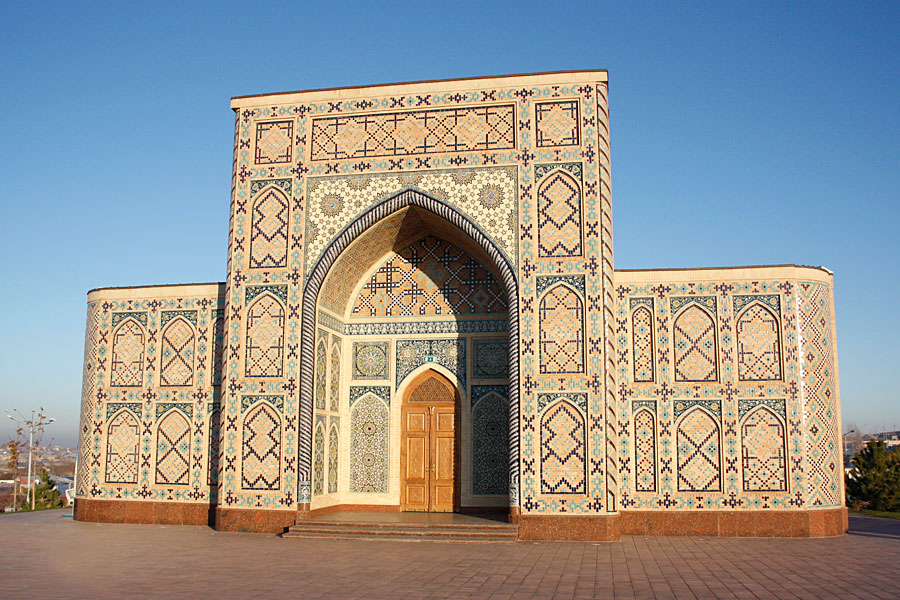 Among historical monuments of Samarkand observatory takes particular place, constructed by Ulugbek in 1428-1429 on one of the hills on height, at the bottom of Chupanat altitude. By Baburㅤㅁㅝㅌ words, which saw the observatory, it was three-storied covered with beautiful glazed titles building of round form 46 meters in diameter, 30 meters in height. In the main hall huge instrument was placed for observations of Moon, Sun, and other stars of the vault of heaven. Observatory was unique construction for its time.
The basis of observatory was giant goniometer (vertical circle), radius of circle was equal 40,212 meters, and the length of arc was 63 meters. The main instrument-sextant-was oriented with amazing exactness by line of meridian from south to north. Test establishments of modern astronomers Kastalsk and Sheglov are the evidence to it. Sizes of the main instrument, lucky construction, scientific knowledge of Ulugbek and his companion-in-arms provided amazing exactness of astronomic observations.
Contribution of creation astronomic catalog-ㅤㅂㅐㄵidji-Gurgani? known as ㅤㅂㅏㅈtar tables of Ulugbek?belongs to Ulugbek. Whole galaxy of great scientists was working on them for a long period and finished them to 1437.
ㅤㅁㅣㅀverything that observation and experience had known about planets movement, is delivered for keeping to this book?Ulugbek was writing. In this work basics of astronomic observations are summarized, made by east scientists.
Exactness of observations of Samarkand astronomers is amazing because they were made without help of optical instruments, with unaided eye. Astronomic tables contents coordinates of 1018 stars. His catalog did not lose its value in our days. With amazing exactness made the calculation of the length of star year, which by Ulugbekㅤㅁㅝㅌ calculation is equal to 365 days 6 hours 10 minutes 8 seconds. Actual length of star year by modern data is 365 days 6 hours 9 minutes 9,6 seconds. Thus the mistake is only less that one minute.
After Ulugbekㅤㅁㅝㅌ death observatory was destroyed and robbed by religious fans. Only in 1908 archaeologist Vyatkin found first document where location of observatory was mentioned. Unfortunately only underground part of sextant and basis of the building were saved. By found documents scientists made the model of the observatory.
Remarkable scientific center was destroyed, valuable library was plundered, and scientists were chased away. Sheikhs announced the hill as the place of grave ㅤㅁㅣㅄorty virgins?and built here mausoleum, place of pilgrimage, bringing big profits to hypocrites. Like this Samarkand priesthood was trying to suppress in people member of torch of science-Ulugbek and his observatory.

